

Why Most Women's Activewear Doesn't Fit And What Brands Keep Getting Wrong About the Female Body.
Why Most Women's Activewear Doesn't Fit And What Brands Keep Getting Wrong About the Female Body
The activewear industry has spent decades designing for an idealized body that most women don't have. Here's the research behind the problem and what proper fit actually requires.
If you've ever pulled on a pair of leggings that fit your hips but gaped at the waist, or found a sports bra that worked in the cup but dug in at the band, or bought activewear in your usual size only to find it fits nothing like what you expected — you are not the problem. The industry is.
Clothing sizes are not standardized. Most brands don't follow a universal sizing system. Instead, a brand may focus their sizing on an athletically built body shape or certain age range, using fit models or the measurements from one smaller person and developing a linear grade of measures from that. The Pencil Test The result is a sizing system that scales up mathematically but fails women anatomically — producing leggings that fit one dimension of a body while completely ignoring another.
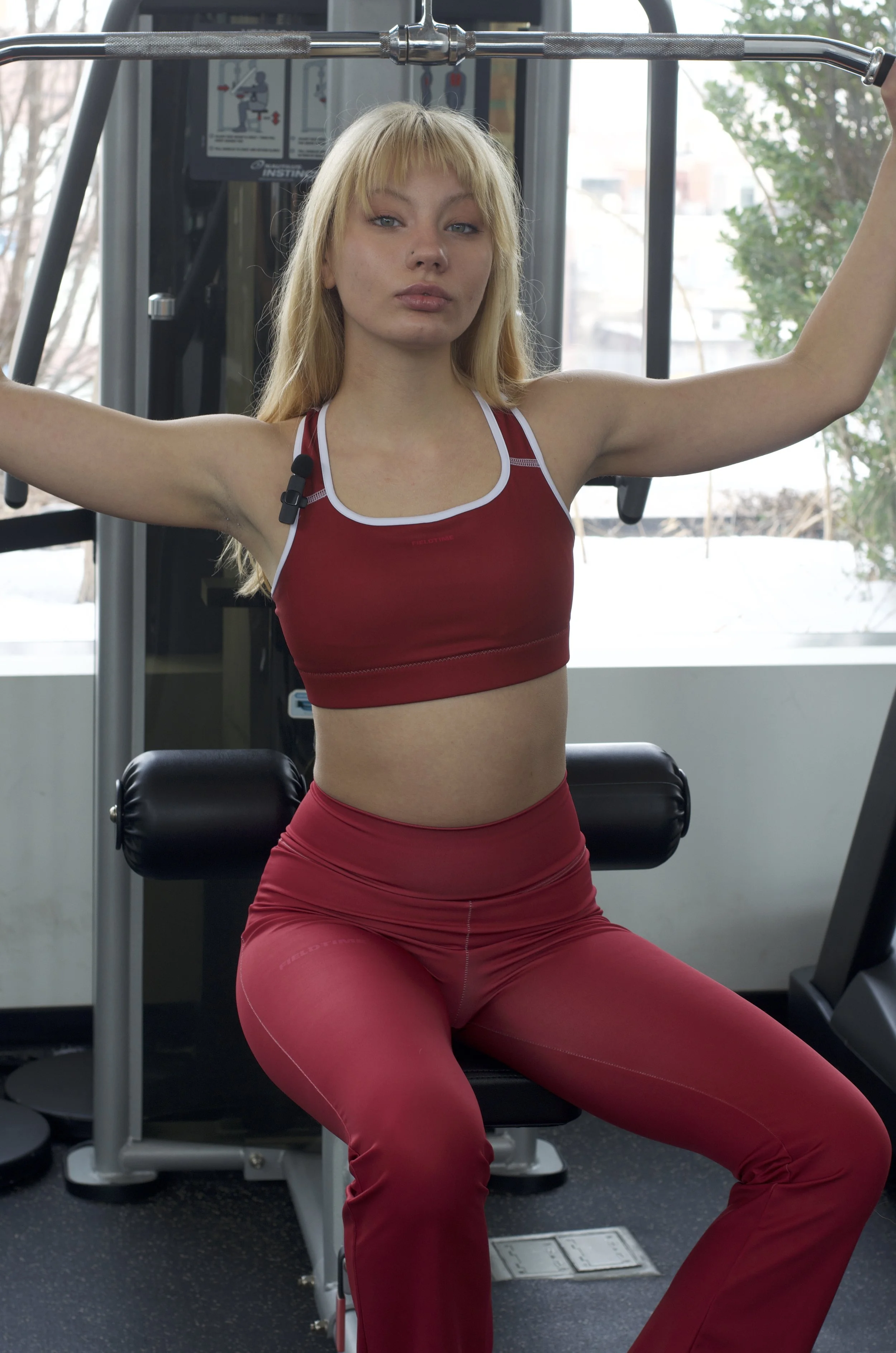
Fieldtime Burgundy flare leggings (Small)
An overwhelming 91 percent of women have experienced variability in clothing sizing across different retailers. LaneBryant In activewear — a category that demands precise fit across multiple body dimensions simultaneously — that inconsistency doesn't just cause frustration. It affects performance, confidence, and whether women show up to train at all.
The Blueprint That Actually Works
The Fieldtime Flare Leggings are built with a high-waisted, butt-lifting cut and a double-layered waistband with an interior pocket. The high waist isn't a trend decision — it's a structural one. High waist leggings are less likely to roll or slide because they cover the abdominal area, which is most likely to expand and contract as you move, bend, sit, and stand. By covering it up, stability is added to prevent that movement from causing the fabric to shift. Title Nine The double-layered waistband provides the internal reinforcement that single-band construction simply cannot — distributing compression evenly rather than concentrating pressure into a narrow strip that digs, rolls, or collapses under load.
The butt-lifting cut isn't cosmetic. It's the result of seam placement and fabric tension being engineered around the actual shape of the glutes — a detail most brands skip entirely because it requires pattern work beyond basic linear grading. The Fieldtime Yoga Leggings add a triangle-shaped gusset crotch panel that reinforces the highest-stress zone in any deep movement and four-way stretch fabric that recovers on both the cross and lengthwise grain. The Capri Leggings carry the same four-way stretch microfiber construction with quick-dry performance built in. All three styles are built for bodies that actually move.
A Sizing System Built for a Body Most Women Don't Have
Clothing sizes are optimized for mass production and appeal, not women's bodies. Fashion designers often use body measurements for a single reference size as a starting point when creating new design samples. Manufacturers then use a mathematical formula to determine each next size up or down the range in a process called grading — where each size is incrementally larger than the last in a uniform shape that makes it easier for factories to mass-produce garments, but comes with significant tradeoffs. It becomes increasingly difficult to scale up to larger sizes before the proportions become distorted. Leonisa
The distortion becomes clear when you look at actual data. Researchers have identified as many as nine different categories of body proportions commonly found among adult women. Most women do not have an exaggerated hourglass silhouette — the median woman is shaped more like a rectangle. Only 12 percent of women have a true hourglass figure. Yet size charts continue to champion a defined waistline as the sole foundation to most women's apparel. Leonisa
For a vast majority of apparel brands, sizing is built around a wooden dummy with an hourglass morphology decided as being most representative. In the USA, this shape fits just 8 percent of all female figures. Thirdlove That means the standard sizing template used across the industry was designed for a body shape that fewer than one in ten women actually have — and every other body shape is either squeezed in or left out entirely.
According to a study published in the International Journal of Fashion Design, Technology and Education, the average American woman wears between a Misses size 16 to 18, significantly larger than the standard sizes offered by most retailers. OneHanesPlace The industry's reference point and the reality of American women's bodies aren't just slightly misaligned — they're operating on completely different assumptions.
The Psychological Cost of Clothes That Don't Fit
The consequences of a broken sizing system go well beyond inconvenience. According to a study from the University of New Hampshire, clothing size is a factor women consider in regard to accepting their bodies, proving that self-worth and numerical sizing are unfortunately linked. Studies found that requiring a larger option than expected not only reduces self-esteem but also creates an overall negative attitude toward clothing. The Pencil Test
When a garment does not fit well, consumers blame their bodies, which results in a negative body image. Unrealistic clothing sizing measures and media promoting ideal fashionable female figures frame standards of beauty and also contribute to negative body image. LaneBryant The body isn't failing the clothes. The clothes are failing the body. But that distinction gets lost in a dressing room mirror, and the psychological damage accumulates over years of being told — implicitly, by ill-fitting garments — that your body is the problem.
Women with bodies that fall outside the narrow template activewear is designed for don't just face limited options — they face the message that they are an afterthought. The proportions are completely different, and just because a brand makes a bra in a larger size doesn't mean the construction has considered those different proportions. To be able to have the same leggings or sports bras as women who are completely different sizes and shapes — that's confidence-boosting. That's an industry saying you're accepted. Berlei
The Rolling Waistband Is a Construction Problem, Not a You Problem
Of all the fit failures in activewear, the rolling waistband is the most universally complained about — and the most preventable. Thin elastic bands without structural reinforcement collapse under pressure and fold inward. Fabric curl caused by an imbalance between waistband tension and body movement contributes directly to rolling. Soft fabrics need internal reinforcement to stay in place. adidas US
Waistband structure is what separates functional leggings from frustrating ones. Thin bands often lack the structural integrity to resist downward pressure, especially during dynamic movements like bending, squatting, or running. Runners Need Most brands prioritize how a waistband looks on a hanger, not how it performs through a burpee, a squat, or a yoga flow — which is why so many leggings that feel fine standing in a store become an hourly adjustment by the third set.
Rolling occurs at the waistband and is often caused by the abdomen pushing on the waistband when moving from sitting to standing, as the skin folds in different ways and can push on the material. Low-rise and mid-rise leggings are most prone because the waist sits right across the belly, which expands and contracts throughout the day. Title Nine A high-waisted double-layered construction solves this at the root — not with a workaround, but with design.
The internal structure matters more than thickness. The best waistband for workout pants has a multi-layered structure to support deeper movements and a secure fit. High-stretch-recovery fibers prevent bagging, sagging, and long-term compression loss. adidas US The double-layered waistband on the Fieldtime Flare Leggings distributes pressure across a larger surface area, eliminating the concentrated pinch that single-band construction creates and providing the structural depth to resist the downward forces that come with dynamic movement.
High-Waisted Is Not a Trend — It's Engineering
The high-waisted legging gets dismissed as aesthetic. The reality is more functional. Research indicates that compression garments like high-waisted leggings can help improve comfort by offering support to key areas of the body, including the lower back and core. This increased support reduces the need for constant adjustments and helps the wearer feel more comfortable and secure in their clothing, whether working out or going about daily activities. Nike
High-waisted leggings are best for high-intensity workouts, yoga, pilates, running, and weightlifting. They provide excellent support, stay in place, and offer a flattering fit. They reduce distractions and enhance confidence — advantages that mid-rise options simply cannot match for dynamic activity. Quora
High-waisted leggings are less likely to roll down because they offer more coverage and support. The waistband sits higher on the torso, often above the belly button, which helps prevent the leggings from slipping down. This is especially beneficial for activities that involve a lot of bending or stretching, such as yoga or pilates. Olaben
The butt-lifting cut compounds this further. When the rear panel is engineered around the actual shape of the glutes rather than graded up linearly from a smaller template, the fabric distributes stretch correctly across the full seated curve. Strategic stitching and compression fabric work together to offer a subtle butt-lifting effect that enhances natural shape while allowing unrestricted movement — a result of intentional design, not luck. Quora
What Fit Actually Requires
Fit in activewear requires more than getting the number right. Sizing inconsistencies across brands are a major source of frustration. A size in one brand may fit very differently than in another. This is why some women find it helpful to experiment with multiple brands — but the real solution is accurate measurement of bust, waist, hips, and inseam, compared against detailed brand-specific size charts rather than relying on a single number. HSIA
Stretch fabrics with a high percentage of elastane — usually 10 to 20 percent — provide four-way stretch that moves in all directions. This flexibility prevents leggings and tops from cutting into skin or restricting motion during exercises like yoga, running, or strength training. The ability of the fabric to recover its original shape after stretching keeps activewear fitting properly over time. HSIA
The gusset panel is the most overlooked fit detail in women's activewear. Leggings without proper gusset construction don't provide adequate coverage during movement, causing the fabric to pull tightly in the wrong places and creating both discomfort and visual issues. Newsweek A triangle-shaped gusset, like the one in the Fieldtime Yoga Leggings, reinforces this zone structurally and allows the full range of motion that deep squats, lunges, and yoga flows actually require.
Your Body Was Never the Problem
The problem is not, and never will be, your body. The fashion industry is notorious for creating sizing systems that aren't consistent. Nothing is wrong with your body because a pair of leggings fits one way and not another — that's the system failing you, not the other way around. The Pencil Test
Fieldtime built their leggings around the bodies women actually have — high-waisted double-layered construction that stays put, butt-lifting cut patterns engineered for real curves, four-way stretch microfiber that moves in every direction without losing shape, and gusset construction that handles whatever the workout demands. That is not a style choice. That is what designing for the female body actually looks like.
Shop Fieldtime leggings at fieldtime.store
Sources: Katie Couric Media (katiecouric.com) · Bold Metrics (boldmetrics.com) · ResearchGate Body Shape and Apparel Size Study · 4-rth Activewear (4-rth.com) · Abyss Athletics (abyss-athletics.com) · Knix (knix.com) · Rexing Sports (rexingsports.com) · V3 Apparel (v3apparel.com) · Tandfonline Journal of Fashion Marketing and Management · Pudding.cool Sizing Analysis